Showing posts with label Nietzsche. Show all posts

Thursday, January 26, 2023

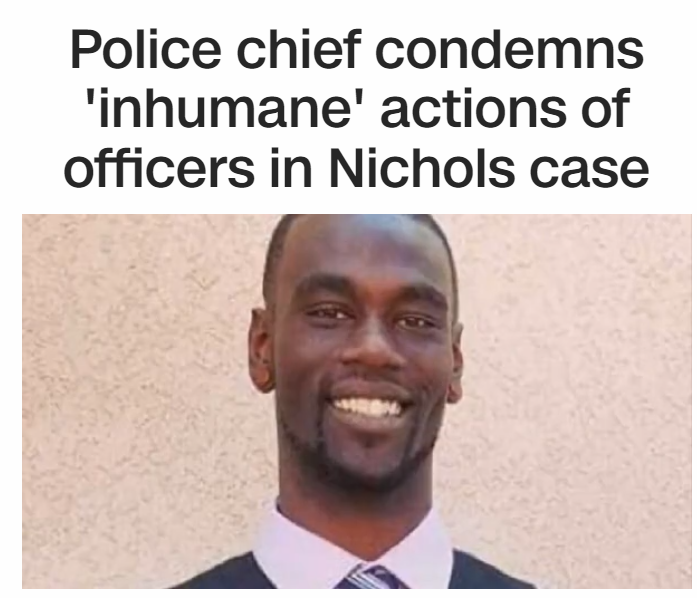
Tyre Nichols and Inhumanity

 Wondering what it is about the profession of policing that seems to produce this inhumanity.


Reminds me of a Larry Wilmore bit after the choking death of Erik Garner:

He agreed with Stewart that it could be something about the uniform that makes cops of all races treat black men differently.

As Wilmore put it, “I once dressed as a cop for Halloween, and by the end of the night I was choking brothers.”

A full believer in the power corrupts adage, one just has to wonder about the hiring practices of police departments now that the force is more able to be recorded and seen by the world.

I can remember around the time the body cameras came out, it was supposed to have a "civilizing" effect on policing.

Why are we hiring police officers that need civilizing?

Is there a mercenary culture undercurrent in police hiring? 

Social Psychologists will not speak of bad apples, but bad barrels. What is it about the power of policing behind the uniform that seems to produce this inhumanity?

Shaking my head as I remember Nietzsche:

"We must take care when pursuing monsters, not to become monsters ourselves."

Sunday, October 17, 2021

Truman Capote, AI, and Comedy

I recently reread Truman Capote's La Côte Basque from my Great Esquire Fiction book and it prompted my research into this story, which prompted this post on Artificial Intelligence and Comedy.

In researching this story and Capote, google kept popping up things about Capote's IQ. After I finished my research of this story (and how it basically ruined Capote's life and resulted in his slow suicide via drugs and alcohol) I went back to the Capote IQ.

Now the internet isn't exactly the place for unequivocal truth, but let's say that Capote's "internet" IQ of 215 is close to the truth. 

Now we know that AI can now write novels and poetry and there is cause to believe it can be "good" or "decent" writing. 

Because AI is a matter of pattern recognition. Recognize enough patterns and you can create, be it skyscrapers or stories. 

This is a crucial point. 

So I thought of comedy. If AI can recognize the parts/patterns of a joke, (set-up, punch line, etc.), it can in theory, create comedy.

So in time we can expect computers to be comedians?

Naw.

Part of what computers and AI can't access or pattern recognize, is feelings. Humans have feelings. And pain. Certainly what drove part of Richard Pryor's comedy was pain. Part of what drove George Carlin's comedy was anger.

Can computers pattern recognize their way to pain or anger?

In my estimation, no.

Pain and anger, (and I say this in my 51st year on the planet, and in therapy), require a biography, a full narrative to draw from.

Computers and AI don't have a past, replete with feelings and memories.

Can computers and AI pattern recognize their way to feelings and memories?

You can see where this is going. An infinite regress, a homonculus with a homonculus with a...


Kurzweil is probably correct about the future and the singularity may be near. And he's probably correct that we shouldn't fear it or the algorithms.

Probably.

I have always been more afraid of humans than anything else, being a student of history.

I certainly do not fear robots and AI creating anything artistic that will rival what humans can do. 

Capote, IQ of 215 and all, was, per Nietzsche, human, all too human, and imperfect and flawed and capable of sadness and regret and shame, in incredible proportions.

Ah feelings, nothing more than feelings.
Trying to forget my feelings...

AI can't feel or forget.

Our (human) art is safe.

Just not from humans.

Get it?


Monday, December 17, 2018

Dispatches


Dispatches finished with me last week; I can't say I'm finished with it.

Though it came out in 1977, it is simply alive; still breathing and kicking and still wrecking people to existential and artistic crisis. 

Case in point:


But then this tidbit from an old interview with Terry Gross:

GROSS: I think it took around 10 years for "Dispatches" to be published after you returned.HERR: Well, it took about nine years. That's because it took about eight years to write it.GROSS: How come it took so long?HERR: That's a long story, you know? It just took a long time. It took what it took, you know? I was afraid to finish the book.

Afraid. 

Books like Dispatches hold up a mirror to humanity.

And sometimes the abyss looks back.


Monday, July 25, 2016

Yazoo Piggly Wiggly


In addition to being an atheist, I am also an amoralist or as some say, a moral nihilist. It’s not as bad as it sounds. I follow laws, I treat people and animals well (as well as can be expected for an omnivore), I drive defensively and follow traffic laws (which is more than I can say for many, many other drivers in the northeastern U.S.). Sure, I had a few scrapes as a kid and even a few in my mid-twenties but I have never been arrested and have only received a few speeding tickets. So I am a lot like you when it comes to behavior in most regards. But if you are not a moral nihilist (or a moral relativist) you believe that there is an objective moral measure of actions/behaviors. In short, some deeds are wrong and some are right. 99% of the time this doesn’t matter one iota because we have (here in the US anyway) a legal system that, to an extent, manages morality for us. The difference for me is that there is no ultimate or objective source of morality – no god to say this is right, period and this is wrong, period. Do this, don’t do that, per god. The Coen brothers had some amoral fun with this in the movie O Brother, Where Art Thou? On the lam after escaping prison Delmar and Pete get baptized and Delmar is touting his absolution when Everett points out the grey area between god and the law:

DELMAR
Well that's it boys, I been redeemed!
The preacher warshed away all my
sins and transgressions. It's the
straight-and-narrow from here on out
and heaven everlasting's my reward!

EVERETT
Delmar what the hell are you talking
about? - We got bigger fish to fry-

DELMAR
Preacher said my sins are warshed
away, including that Piggly Wiggly I
knocked over in Yazoo!

EVERETT
I thought you said you were innocent
a those charges.

DELMAR
Well I was lyin' - and I'm proud to
say that that sin's been warshed
away too!  Neither God nor man's got
nothin' on me now! Come on in, boys,
the water's fine!

(later…)
PETE
The preacher said it absolved us.
 
EVERETT
For him, not for the law! I'm
surprised at you, Pete. Hell, I gave
you credit for more brains than
Delmar.
 
DELMAR
But there were witnesses, saw us
redeemed!
 
EVERETT
That's not the issue, Delmar. Even
if it did put you square with the
Lord, the State of Mississippi is
more hardnosed.

So like I say 99% of the time, my amorality won’t be an issue, won’t cross with your moral objectivity. But when you think about it, when you really think about it, Delmar has got a point. So heaven is by far the most important goal is it not? What can possibly trump heaven? How can Mississippi, as Everett states, be more hard-nosed than the requirements for eternal bliss? One can be square with the lord but not a state? When did state or federal governments enter the pantheon of moral fiber such as to usurp god’s place in judging humans? Isn’t this putting the cart before the horse? Don’t laws flow from morality and not the other way round? See, I told you they had fun with it.
So for me, human laws are the ones that really matter and as anyone who’s lived on this planet for more than four years knows, humans are endlessly fallible. Henceforth, our laws are fallible. Our ability to follow laws, be ethical, do the dishes, or to prevent the Broncos from driving 98 yards in 1987: all fallible. But if we’re all fallible and realize said fallibility, then we are all on the same page: not some appealing to god and others not. And there is a lot, a huge amount actually, to being on the same page. Good rulers know and have known the importance of standardization.  Deciding what a pound is or an acre is puts everyone on the same page, whether you are farming an acre, buying an acre, or selling an acre. Our so called objective morality is nothing but a stab at standardization – a stab at getting everyone on the same page. It’s the process, the steps to get there that actually end up throwing a wrench in the system. Instead of appealing to just the importance of standardization and trusting in this (and a leviathan or state to enforce said standardization) some folks said no no no, we need some more muscle if we really want this to stick. Let’s not only tie it to this life (laws) but let’s also tie it to everlasting life and instead of this-life or earthly enforcement, let’s enforce via eternal salvation or eternal damnation. That should get these people to straighten up and fly right. Hmm, we’re going to have to codify some things from the almighty. Hmm what to codify, how to communicate messages from an unearthly being to earthly beings? Hmm…
 History is nothing if not proof that this little effort failed at a grotesque level and actually did more harm than good. So again as Nietzsche said “human, all too human” but at least we’re all in this amoral world together and can make it better or at least more manageable on a day to day basis just by accepting our very fallible standardization – perfection isn’t the goal, consistency and not getting murdered for thinking the wrong thing is.
Wednesday, November 18, 2015

Paris


I think if you look at my blog dear blog reader you will see that I get a lot of mileage out of the quotation associated with Nietzsche that “we must take care when pursuing monsters, not to become monsters ourselves.”

And in the light of the Paris attacks and the ongoing culture wars over immigration and Syrian refugees, you might think that we are becoming monsters.

Another quotation/idea that resonates with me is that we show our character in times of crisis.

So if you listen closely and you read between the lines, you will know that freedom of religion, charity, and diversity are great when things are going swimmingly but insert crisis and then watch what happens.

Equality goes out the window.

Which devotees does god love the most? Christians, Muslims…

Thursday, July 16, 2015

Monsters and Heroes


One theme that crosses my mind a lot as I meander through life, be it watching the news or dissecting plots of movies, is this idea that, though it is attributed to Nietzsche, but must have been around before him, one must take care when pursuing monsters, not to become a monster. I first met this theme in the 1988 movie Criminal Law with Kevin Bacon. I would go on to read Nietzsche in undergrad but he never caught on with me the way other philosophers did like Heidegger and Leibnitz. But, like I said, the theme crosses my mind often because of the power and length of its reach – torture of Iraqis, mass incarceration of nonviolent drug offenders, etc. Recently, I have found another theme that is crossing my mind a lot and I think I first met this theme in the 1998 movie The Big Lebowski with Jeff Bridges. 

Here is a lil something from the script:

INTERIOR   RALPH'S

               It is late, the supermarket all but deserted.  We are tracking
               in on a fortyish man in Bermuda shorts and sunglasses at the
               dairy case.  He is the Dude.  His rumpled look and relaxed
               manner suggest a man in whom casualness runs deep.

               He is feeling quarts of milk for coldness and examining their
               expiration dates.

                                     VOICE-OVER
                         Now this story I'm about to unfold
                         took place back in the early nineties--
                         just about the time of our conflict
                         with Sad'm and the Eye-rackies.  I
                         only mention it 'cause some- times
                         there's a man--I won't say a hee-ro,
                         'cause what's a hee-ro?--but sometimes
                         there's a man.

               The Dude glances furtively about and then opens a quart of
               milk.  He sticks his nose in the spout and sniffs.

                                     VOICE-OVER
                         And I'm talkin' about the Dude here--
                         sometimes there's a man who, wal,
                         he's the man for his time'n place,
                         he fits right in there--and that's
                         the Dude, in Los Angeles.

So I ask you: What’s a hero?

Just as you must take care when pursuing monsters, you must also take care when you designate a hero.

By all accounts, ok most account I suppose, Bill Cosby was a hero. And now, it appears that the man is by all but a few accounts (his own and his wife Camille’s?), and I realize this is a strong term, a monster.

Perhaps it is best if we take care when pursuing monsters and that we never designate anyone a hero. 


i'm also tired
of hearing about
"innocent victims".
this is an outmoded idea.
there are no
"innocent victims".
if you live on this planet,
you're guilty.
period.
fuck you.
end of report, next case.
NEXT FUCKING CASE!
next case.
your birth certificate
is proof of guilt.

 …I might add that your birth certificate is also proof that you and no one else, is a hero. Too many warts, too many skeletons in closets, too many lies told, too many indiscretions, too much collateral damage for anyone to be a hero. You’ve hurt others directly, indirectly, you’ve caused pain and anguish. 

How can one be both a hero and a human, what with all the human fallibility?

Now you might counter that if there are no hero’s then there are no monsters and I would hear you out.

But let us come full circle to Nietzsche and admit, at bottom, that you, me, all of us are

human, all too human.


Featured Post

In The Static

He had about 4 hours and 30 minutes. He, like Jack London, was going to use his time. What else did a man have…but time? Christians hav...